I LOVE getting surprises in the mail! It's like Christmas or a birthday when a box full of unknown goodness arrives on your doorstep with an air of mystery surrounding it.
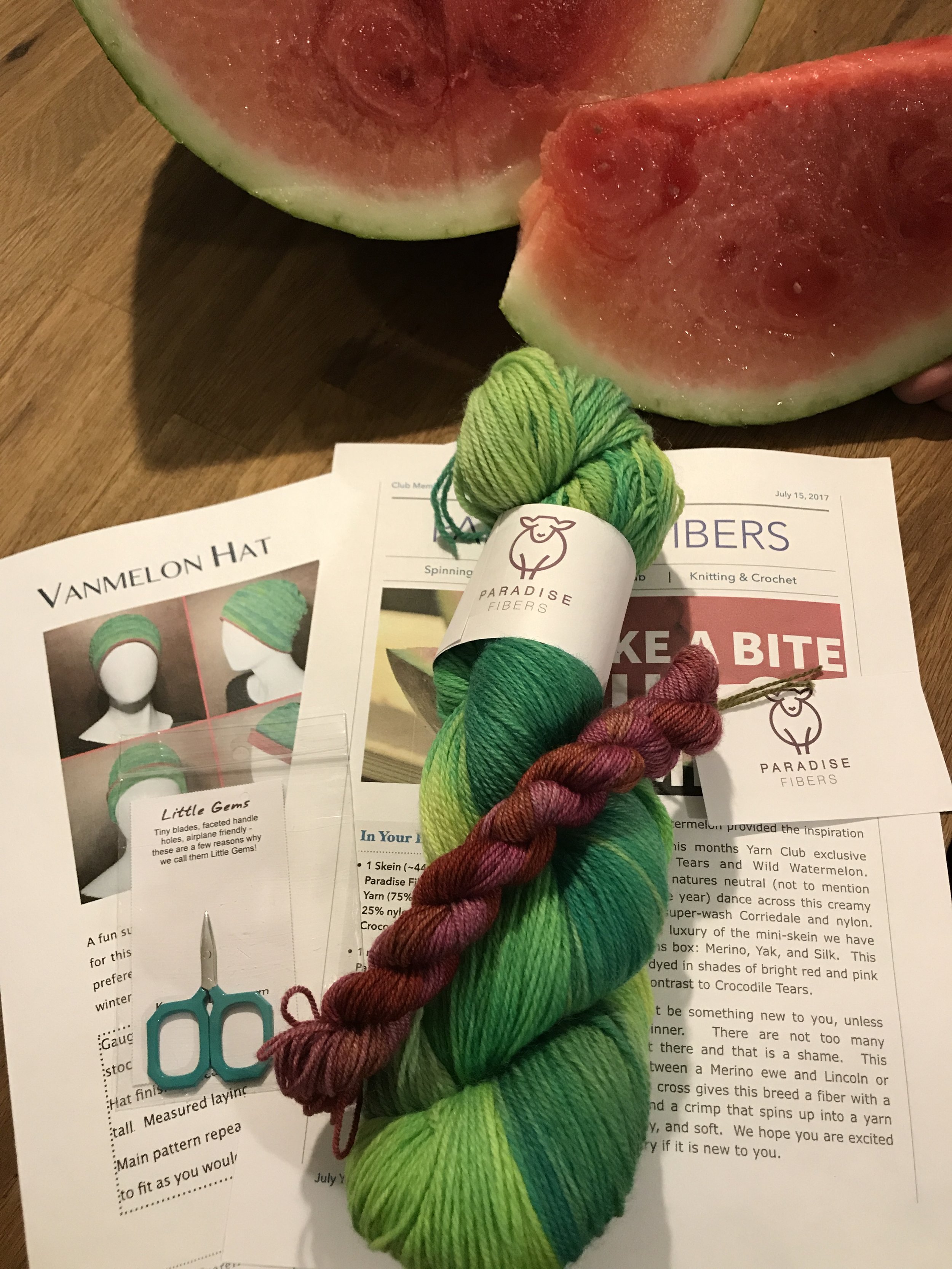
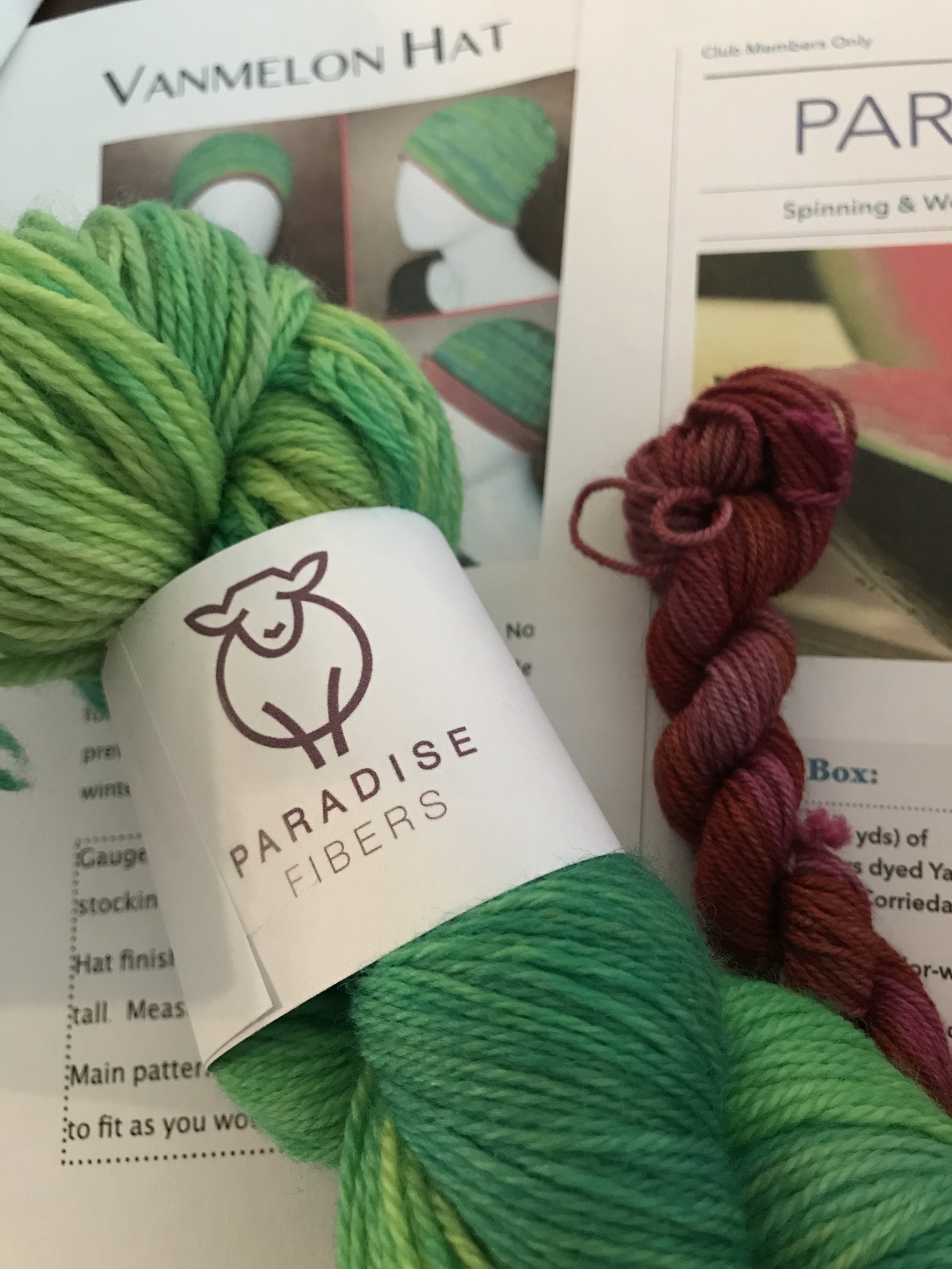
One such package arrived on my stoop and I couldn't wait to open it! Paradise Fibers out of Spokane, WA, has a Yarn of the Month Club, and July's box arrived last night! I was delighted to be asked to do the reveal and find a skein of Yamhill (434 yards, 75% superwash Corriedale/25% nylon), a fingering weight in a club-exclusive color way Crocodile Tears (huzzah for green, my favorite color!) and a Lotus mini skein of Wild Watermelon (48 yards, 60% merino superwash/20% yak/20% silk - luxurious). Both skeins offer up enough yardage to knit the Vanmelon Hat, the pattern included in the box. My watermelon-obsessed husband - who happened to be eating a watermelon when I opened the box - was very excited about the colors!
What I liked about this club was the newsletter itself, giving me an explanation of the fibers in the yarns (I always find fiber content and breed-specific info very interesting), as well as info on the colors (the green is the Pantone color of the year). While I don't foresee myself knitting the hat pattern provided in the box, the green is gorgeous and summery and is calling out for me to make it into a lacy shawl of some sort. Tucked in the bottom of the box was a very handy pair of tiny scissors called Little Gems - perfect for travel knitting. We do a lot of driving in the summer and I do a lot of knitting on the go, so small blades that are easy to bring with me and tuck in a pocket or small bag when I fly are a must. I loved the mystery element of this club. Not knowing what kind of fiber or color I was getting had me anxiously awaiting the box's arrival. I love knitting surprises and was not disappointed!
I'm always wondering what to get my knitting friends for the holidays, and the Yarn of the Month Club would be a great gift. Each monthly box is $31.95 (US, includes shipping) and includes a custom dyed yarn by Paradise Fibers or other brands like MadTosh or Ancient Arts, a supporting pattern, a newsletter, a fun goodie, plus a 10% off regular-priced yarn purchase through Paradise Fibers. If you post pics of your yarn box on Instagram or Ravelry, you have chances to win Paradise Points that can be used for future purchases.
Thank you to Paradise Fibers, who sent me this box in exchange for my honest review.
Check out this amazing convenience store made entirely out of felted objects! I get hungry just looking at the pictures! Original article here.
Artist Lucy Sparrow Opens an Entire Convenience Store of Handmade Felt Products in Manhattan by Christopher Jobson
If you have a late-night hankering for some felty gefilte fish or a bottle of fermented fabric, be sure to stop by 8 ‘Til Late, the newest temporary installation by British artist Lucy Sparrow known for her felt recreations of everyday objects. Located in Manhattan at The Standard, High Line, the bodega is filled from floor to ceiling with thousands of objects you might find at a typical corner store from breakfast cereals, a deli counter brimming with meats, frozen foods, and spirits—all made from felt and a bit of paint. And just like a real store, every last thing is for sale.
Over the last few years Sparrow has exhibited her felt objects in galleries and art fairs around the world including Art Basel, Scope Miami, and the New York Affordable Art Fair. 8 ‘Til Late is a companion piece to her 2014 installation in London titled The Corner Shop with a similar concept but with Eurocentric products. We have word that lines stretched around the block the last few days and every object in the store has since sold. While originally scheduled to be open through June 30th, the exhibition is ending early, specifically 10pm tonight. So if you’re nearby, now’s your chance. Maybe?
You can see the finer details of some 400 individual items from 8 ‘Til Late on Sparrow’s website.
My mom's book club read a book called Snow Flower and the Secret Fan years ago. She saved it for me to read and it was one of those stories that stuck with me. Without giving the plot away, a 19th-century Chinese girl exchanges secret coded messages back and forth on a silk fan. It reminded me of knitting and how easy it would be to tuck secret messages into the knits and purls, just like knitters did during WWI and WWII. I came across an article recently on just that and wanted to share. We always knew knitters were clever! ;) Original article found here.
The Wartime Spies Who Used Knitting as an Espionage Tool
DURING WORLD WAR I, A grandmother in Belgium knitted at her window, watching the passing trains. As one train chugged by, she made a bumpy stitch in the fabric with her two needles. Another passed, and she dropped a stitch from the fabric, making an intentional hole. Later, she would risk her life by handing the fabric to a soldier—a fellow spy in the Belgian resistance, working to defeat the occupying German force.
Whether women knitted codes into fabric or used stereotypes of knitting women as a cover, there’s a history between knitting and espionage. “Spies have been known to work code messages into knitting, embroidery, hooked rugs, etc,” according to the 1942 book A Guide to Codes and Signals. During wartime, where there were knitters, there were often spies; a pair of eyes, watching between the click of two needles.
When knitters used knitting to encode messages, the message was a form of steganography, a way to hide a message physically (which includes, for example, hiding morse code somewhere on a postcard, or digitally disguising one image within another). If the message must be low-tech, knitting is great for this; every knitted garment is made of different combinations of just two stitches: a knit stitch, which is smooth and looks like a “v”, and a purl stitch, which looks like a horizontal line or a little bump. By making a specific combination of knits and purls in a predetermined pattern, spies could pass on a custom piece of fabric and read the secret message, buried in the innocent warmth of a scarf or hat.
Phyllis Latour Doyle, secret agent for Britain during World War II, spent the war years sneaking information to the British using knitting as a cover. She parachuted into occupied Normandy in 1944 and rode stashed bicycles to troops, chatting with German soldiers under the pretense of being helpful—then, she would return to her knitting kit, in which she hid a silk yarn ready to be filled with secret knotted messages, which she would translate using Morse Code equipment. “I always carried knitting because my codes were on a piece of silk—I had about 2000 I could use. When I used a code I would just pinprick it to indicate it had gone. I wrapped the piece of silk around a knitting needle and put it in a flat shoe lace which I used to tie my hair up,” she told New Zealand Army News in 2009.
A knitting pattern, to non-knitters, may look undecipherable, and not unlike a secret code to begin with. This could cause paranoia around what knitting patterns might mean. Lucy Adlington, in her book Stitches in Time, writes about one article that appeared in UK Pearson’s Magazine in October 1918, which reported that Germans were knitting whole sweaters to send messages—perhaps an exaggeration.
“When the German authorities carefully unraveled such a sweater, the story went, they found the wool thread dotted with many knots. By marking a vertical door frame with the letters of the alphabet, spaced an inch apart, the knots could be deciphered as words by measuring the yarn along this alphabet and marking which letters the knots touched.” Adlington writes, adding that the magazine described this as “safer, and not apt to be detected.” As with many things spy-related, getting the proof and exact details on code knitting can be tricky; much of the time, knitters used needles and yarn as a cover to spy on their enemies without attracting suspicion. Knitting hidden codes was less common.
The Pearson’s account of code knitting seems a bit convoluted, but the rumors were not pure fantasy. Because women were encouraged to knit socks, hats, and balaclavas for soldiers during many conflicts, including the American Civil War, and the World Wars, knitting and textile work was a common sight—and one that could be easily used to the spy’s advantage. In Writing Secret Codes and Sending Hidden Messages, Gyles Daubeney Brandreth and Peter Stevenson note that after Morse Code was invented, it was soon realized that string or yarn suit it well. And “an ordinary loop knot can make the equivalent of a dot and a knot in the figure-eight manner will give you the equivalent of a dash.”
The most famous example of knitting in code comes from fiction; in A Tale of Two Cities, a bloodthirsty French woman named Madame Defarge knits coolly among the audience while the guillotine beheads French nobles, and zealously creates a series of stitches to encode names of nobles that will be executed next. “Despite involvement of Madame Defarge to take up knitting as a source of code, the use of knitting in espionage has nonfictional roots in the United Kingdom during the Great War,” writes Jacqueline Witkowski in the journal InVisible Culture. During the same time that the UK banned knitting patterns for fear of hidden messages, British Secret Intelligence agents hired spies in occupied areas who would pose as ordinary citizens doing ordinary things, which sometimes included knitting.
Madame Levengle was one such woman, who “would sit in front of her window knitting, while tapping signals with her heels to her children in the room below,” writes Kathryn Atwood in Women Heroes of World War I. Her kids, pretending to do schoolwork, wrote down the codes she tapped, all while a German marshal stayed in their home. The Alice Network, a collection of spies and allies in Europe who were experts in chemistry, radio, photography and more, employed “ordinary people who discovered unusual but extremely effective ways to collect information,” Atwood explains.
In many cases, just being a knitter—even if you weren’t making coded fabric—was enough of a cover to gather information, and this tradition continued decades later during World War II. Again in Belgium, the resistance hired older women near train yards to add code into their knitting, to track the travel of enemy forces. “This enactment led to the Office of Censorship’s ban on posted knitting patterns in the Second World War, in case they contained coded messages,” Witkowski writes. Knitting used by the Belgian Resistance during World War II included dropping a stitch, which forms a hole, for one sort of passing train, and purling a stitch, which forms a bump in the fabric, for another, which helped the resistance track the logistics of their enemies. Elizabeth Bently, an American who spied for the Soviet Union during World War II and later became a US informant, used her knitting bag to sneak early plans for the B-29 bombs and information on aircraft creation.
Female spies during the American Revolutionary War also used the “old women are always knitting” stereotype to their advantage. Molly “Old Mom” Rinker, a spy for George Washington during the Revolutionary War, sat on a hilltop and pretended to knit while spying on the British, according to An Encyclopedia of American Women at War. She then hid scraps of paper with sensitive information in balls of yarn, which she tossed over a cliff to hidden soldiers right below, under the noses of the enemy.
Knitting, spying and secret messages so often go hand-in-hand that knitters around the world have figured out ways you, or the knitter in your life, can make your own secret knitting codes. Non-spying knitters make gloves and scarves from the Dewey Decimal system, Morse code, and binary programming language for computers, treating knits and purls like zeros and ones. The possibilities are so apparently endless, it might even be worth learning to knit to give it a try. Plus, if you do pass on knitted code, you’ll be joining a longstanding tradition of textile-making spies.
Can I just say how much I LOVE this?!! Original article found here.
---------------
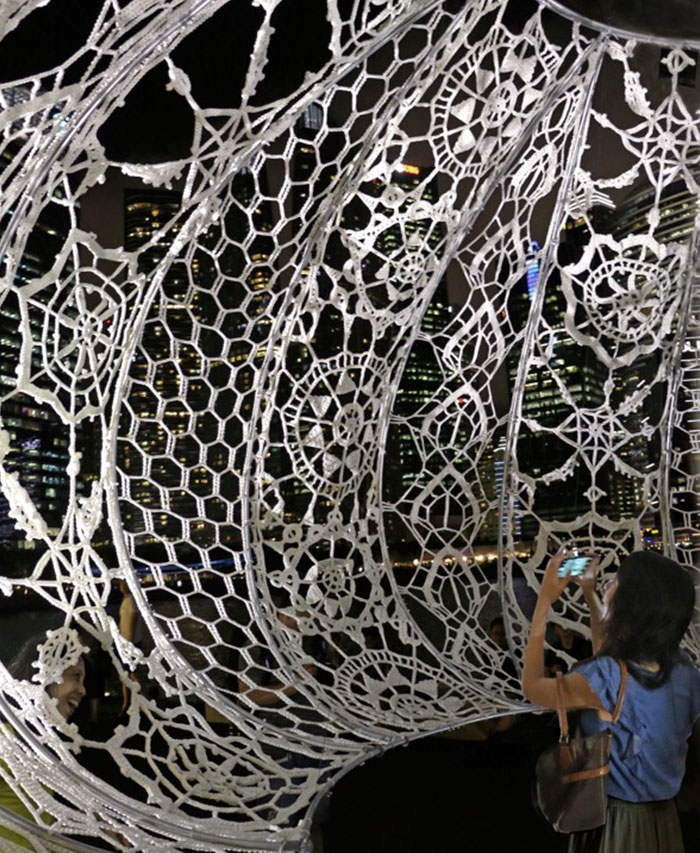
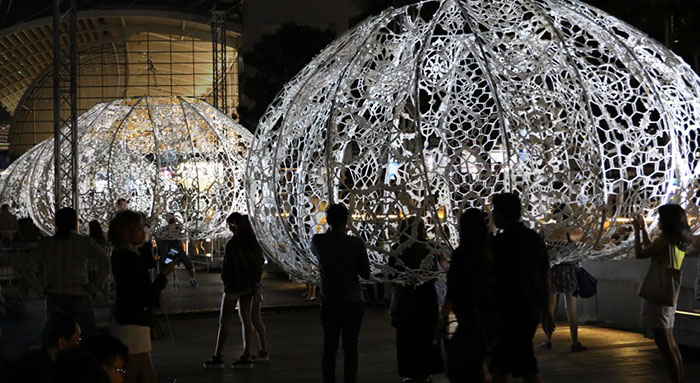
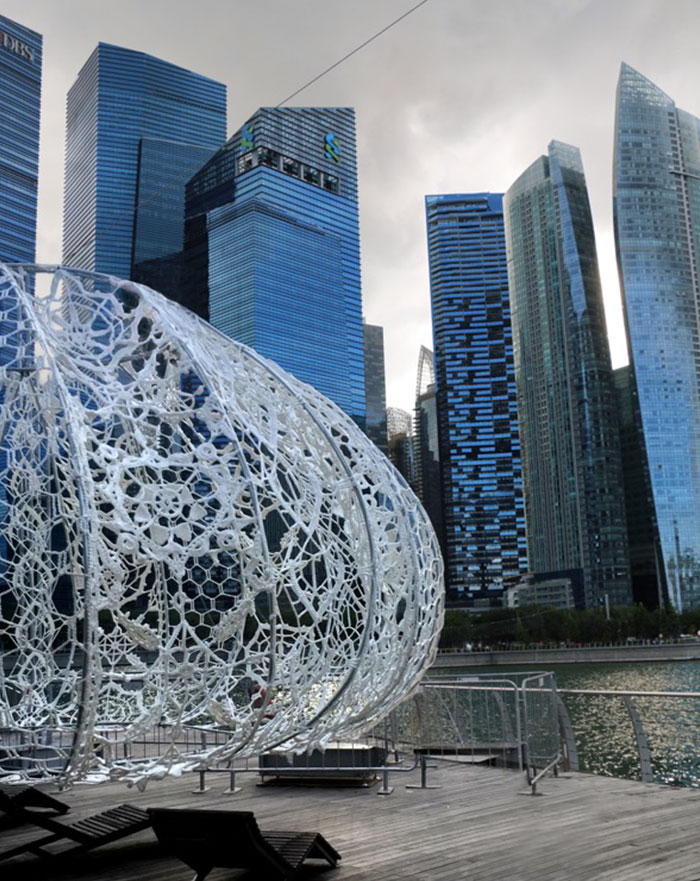
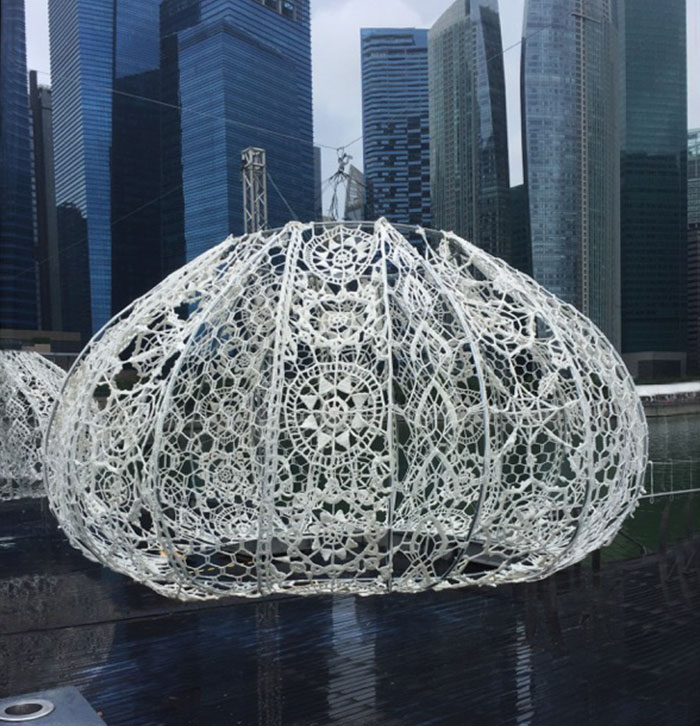
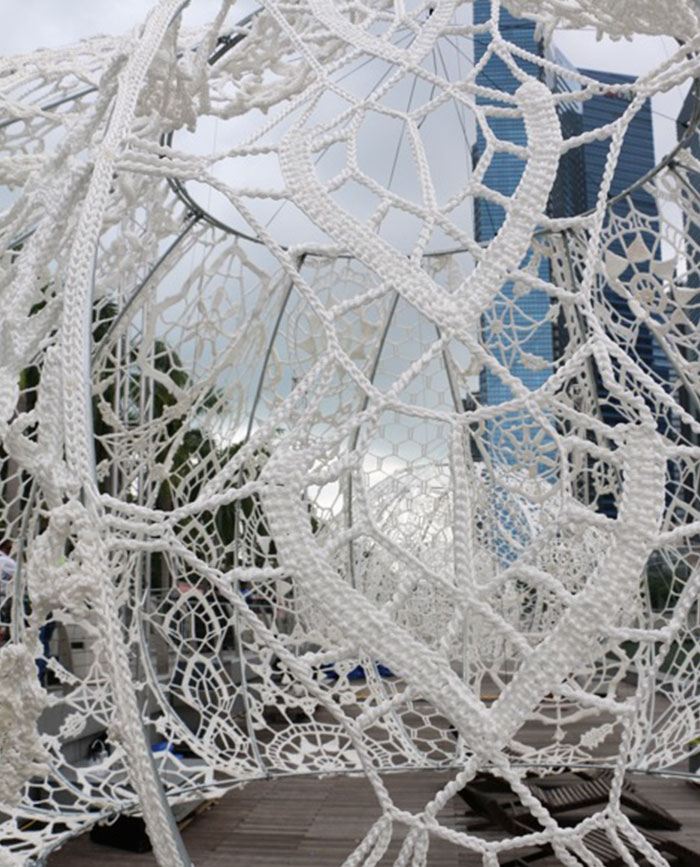
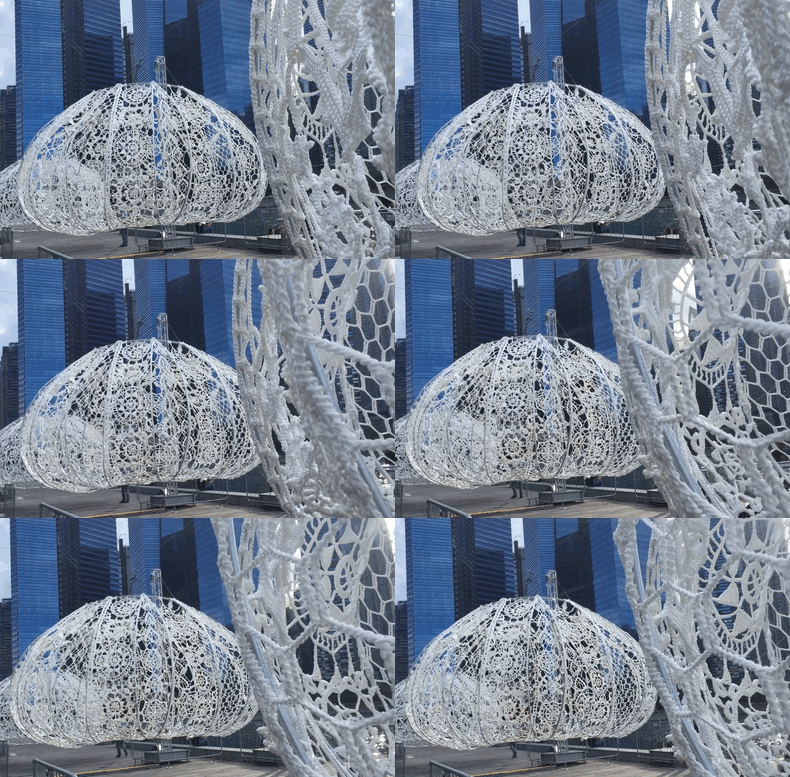
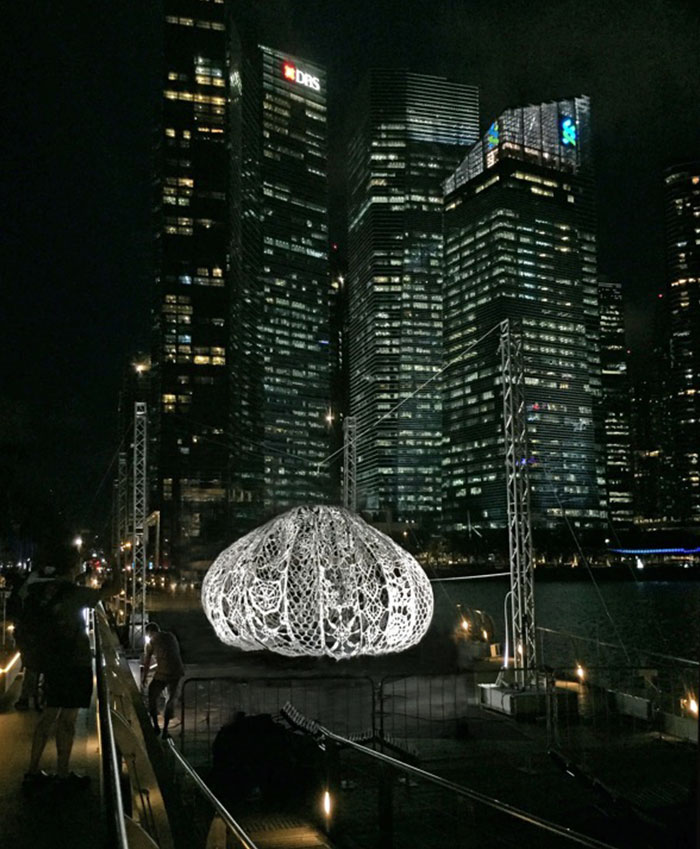
50 People Spend 2 Months To Crochet Giant Urchins Above Singapore’s Marina That Each Weight 220 Lbs (100Kg)
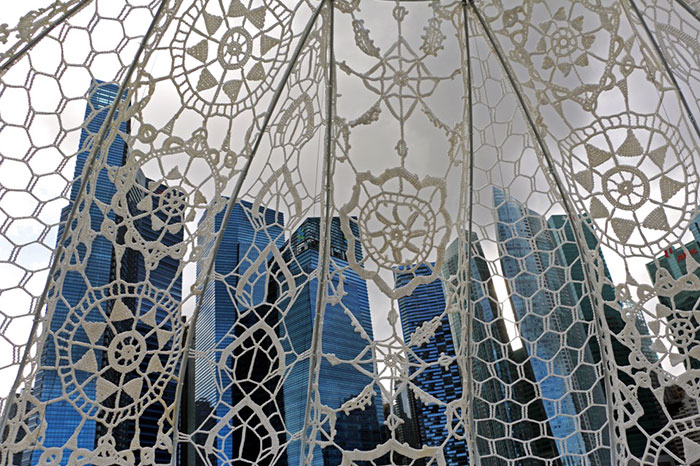
Remember when crocheting was something only your grandma could get excited about? Well, the times have changed and so did crocheting, which in the 21st century has become way more impressive, as you’re about to witness thanks to these giant crocheted urchins floating above Singapore’s Marina Bay.
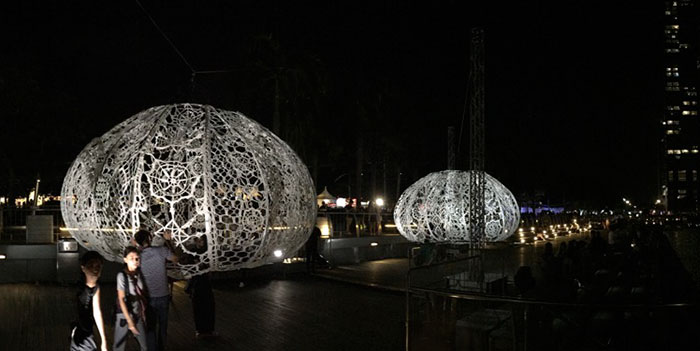
A team of 50 people has spent 2 months twisting the double-braided polyester chords to create this trio of urchins that interact with natural light during the day, and glow when illuminated at night. A single urchin is about 56 feet (17 meters) in size and weighs about 220 pounds (100 kilograms).
The idea behind the art piece is to disrupt the mundane routine of daily life: “Seeing hovering and glowing lacy objects against majestic skyscrapers and dark water would make them pause and gaze. This momentary pause of the mundane routine of our life would hopefully give us an opportunity to find the poetry around us.”