Snowed In

There's a large snow-covered lump in my driveway that I assume is my car. Pulling back the curtains this morning in the bedroom, I was greeted by the kind of icicles you see in films - the huge long ones that look deadly yet beautiful. We are getting absolutely slammed by snow this weekend and day 3 of being alone with a 4-year-old and ancient pug while holed up inside is starting to make us all a little stir crazy. I love a good snow, but I'd probably love it more if my husband wasn't off in Florida at a work convention and I didn't know the snow shovel and I were going to be spending a lot of quality time together later. purple1
Crafty folks handle the snow probably better than anyone else out there! We knit, we crochet, we sew, we edit photos, we dream up designs and sketch while cramming the next load of laundry in just in case we lose power. Snow gives us time to organize our stash, dream of that special skein in our LYS we've had our eyes on, comb through our Ravelry queue and maybe cast on that project we've been dying to start. Snow forces everyone to take a step back, accept that you're not leaving the house anytime soon, put the kettle on, grab your WIP and as we say in our house "snuggle down."
purple4

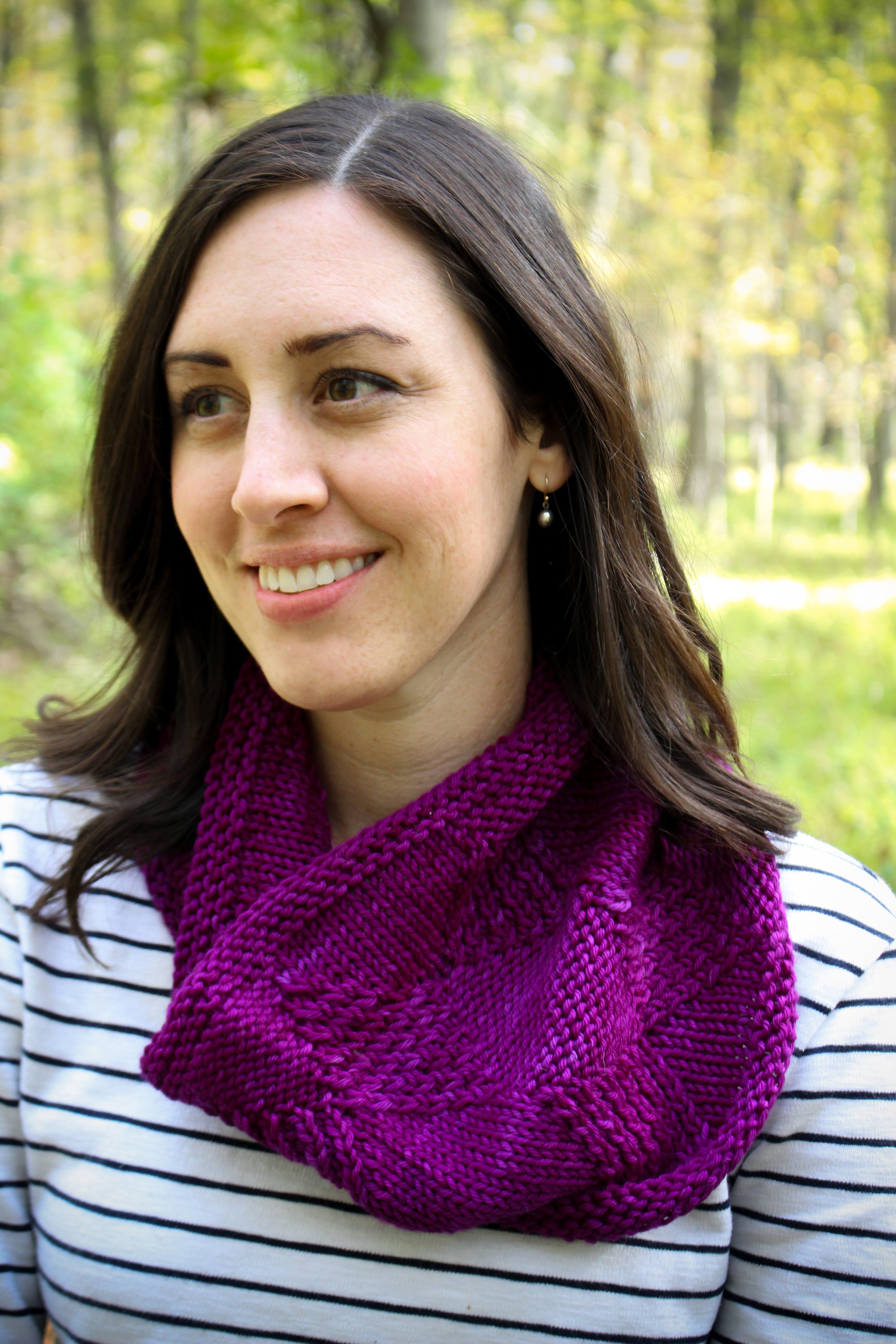
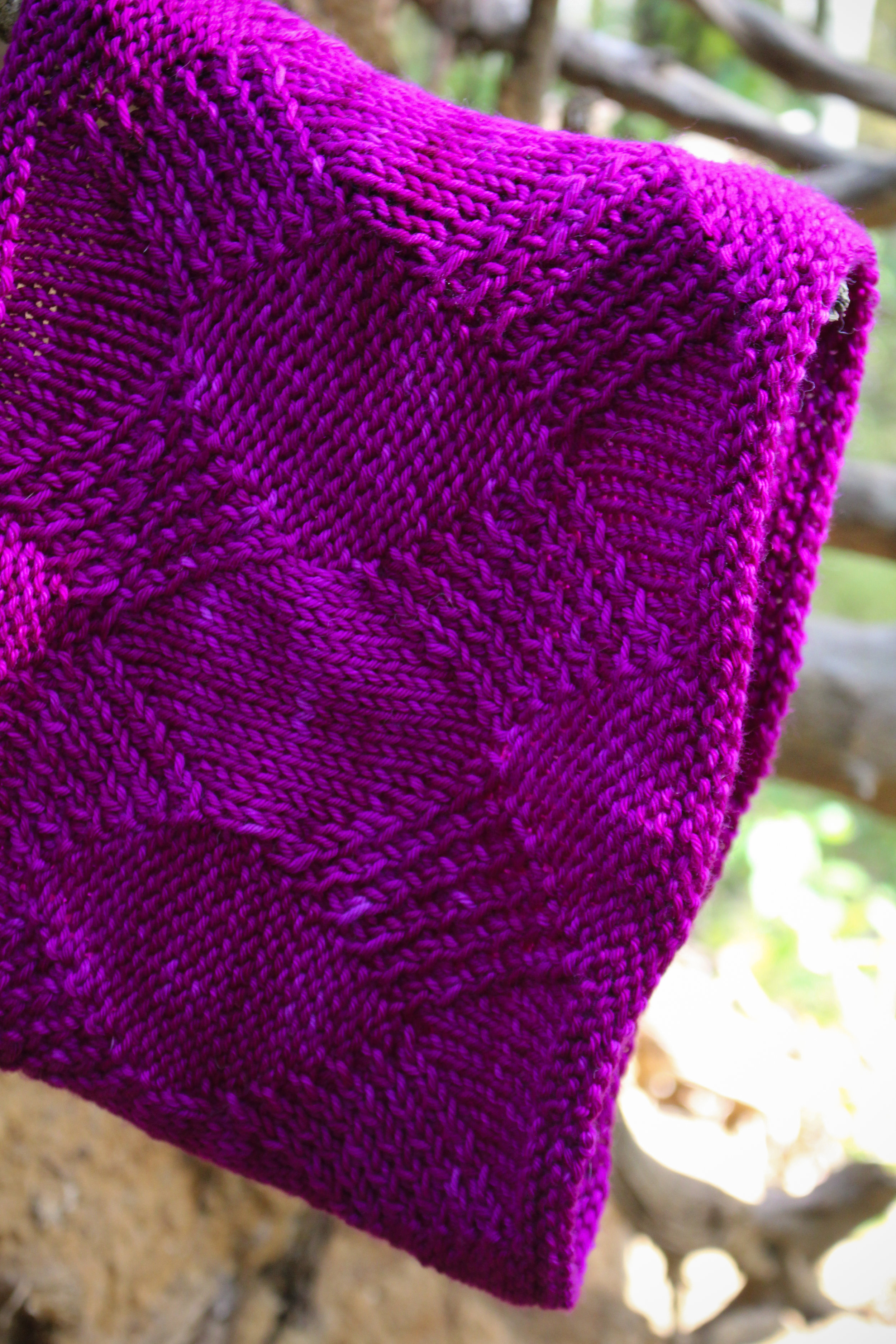
I had planned on introducing a new cowl pattern next week, but since the snow is well past my pug's head and the cars up and down the street look like huge white gumdrops, today seems like a good day. Knitters, meet the Popplewell Cowl! Inspired by argyle (without the argyle), this twisted cowl is only knits, purls, right and left twists. Knitting up on US 10s, this is a project that can easily be started and bound off by the time this storm makes its grand exit.

diamonds1


Bulky yarn means faster knitting and knit up in a solid (the lovely and gorgeous SweetGeorgia Superwash Six) version and a self striping (the very affordable and colorful Plymouth Yarns Gina Chunky) version, you get a completely different look by just changing up the yarn. The pattern is both written out and charted and a perfect time to try your hand at cabling without a cable needle. Each cable is only two stitches (these are called right and left twists), making it both manageable and ideal for tucking that cable needle back into your notions bag and giving it a go without! There's information in the pattern about how to do that if it's something you had on your "new year's knitting resolutions list."

diamonds2

Since there was no school on Thursday, or on Friday and today (day 3) we find ourselves buried with no end in sight, the Popplewell Cowl will be 30% off until midnight tomorrow. Enter the code SNOWDAY at Ravelry checkout to receive your discount!

Stay safe and warm, knitting friends!

Poppelwell Cowl available for download here.


Sew Far, Sew Good

I love your feedback, readers! Want to see more or something or have an idea to share? Let me know! One thing I hear often is "I like how you feature other crafty people or articles I probably wouldn't have seen otherwise." The crafting world is HUGE and even the definition of what is "crafty" is very open-ended. I frequently stumble upon people doing unique things or using their crafting super powers to make the world a bit brighter, a bit more beautiful and a bit more interesting online. I usually find these articles by chance and try to make a point of sharing them with you.

I love sewing (and my project bags in my Etsy shop are a way for me to relax, sew and take a break from knitting).  I've done my fair share of cross stitch, but when it comes to embroidery, I'm not great at it. I so (sew) admire people who not only do it well, but put a unique spin on it. Check out the incredible work by Danielle Clough, a VJ who embroiders stunning work onto tennis rackets. Original article posted here.

Sew Far, Sew Good: I Embroider On Old Tennis Rackets

I always stumble over my words when I answer the typical “so what do you do?” question. I’m a designer by training. I’m passionate about film photography, and I work as a VJ (which means I do visuals for music shows, and not what you think. Yeah, I know…). But lastly, and the most loudly, I say “embroiderer.” I love that term. It’s like being a carpenter or a bricklayer, because there is a simplicity to it, to being a ‘maker’. This is why I create the work.

There is a rhythm to sewing that I find extremely calming, matched with an unadulterated celebration of color, and then at the end I’ve produce something aesthetically-pleasing, so there is great reward in that entire process.

The first threadsketch I created was through a series of opportunities and mistakes. I was working at a gallery at one stage, with idle hands, and at the time I had nothing on me except cotton, a needle and a scrap piece of felt in my bag. I believe I drew a rabbit. Ideally, I shoot all my references, and much like traditional embroidery, I map out the lines before I move on to thread. There are no rules to my process, purely because I don’t really know any of the rules, and those that I do, I try my best to ignore, and in so that way I cannot know what I’m doing wrong. It’s a self-imposed freedom that makes embroidery feel like play.

Motivation and inspiration are two very different forces in my work, and are not mutually exclusive. I’m often motivated by boredom. Apparently I suffer from ‘ADS’ – always doing something. Inspiration comes from finding new materials to use: strange color palettes, conversations with good company and so on. Inspiration keeps me stitching through the times that I lack motivation, and vice-versa.

More info: danielleclough.com

Tulips

Blue paper petals

Rose

What a racket

Other works: Molly

Steve Zissou

Chewy

Silent

Hand Naai

Nonku

Pineapple pendant

Skull pendant

Humming bird

Neapolitan Baby Blanket

UPDATE 1/8/16: Congratulations to winner Gillian! Gillian, check your email! --------------------------------------------------

Despite my fate of coming from a long line of lactose-intolerant Gray's, I love Neapolitan ice cream. I can't remember the last time I had it, but there's just something about it. Is it the bright splash of color in a dish? The delightful combination of strawberry, vanilla and chocolate, all classic choices swirling together in a wonderful jumble of sticky, sugary goodness? I don't know, but it's good stuff.

neo4

Our friends at Wikipedia tell us, "Neapolitan ice cream was named in the late 19th century as a reflection of its presumed origins in the cuisine of the Italian city of Naples, and the many Neapolitan immigrants who brought their expertise in frozen desserts with them to the United States. Spumoni was introduced to the United States in the 1870s as Neapolitan-style ice cream. Early recipes used a variety of flavors; however, the number of three molded together was a common denominator, to resemble the Italian flag. More than likely, chocolate, vanilla, and strawberry became the standard for the reason that they were the most popular flavors in the United States at the time of introduction." That's probably more than you ever wanted to know, but next time you dive into a bowl of this magical dessert, now you know the history.

neo2

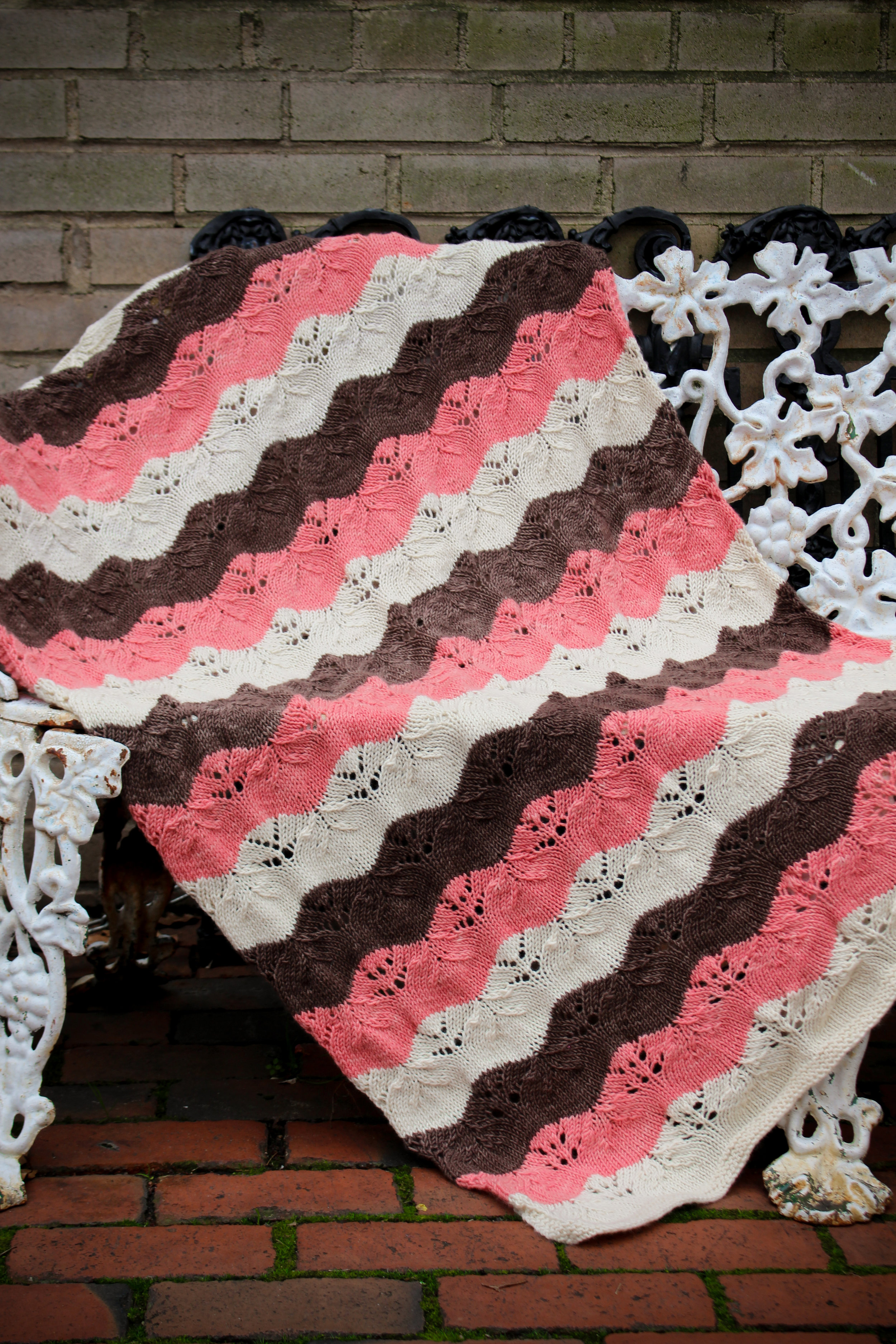
With that in mind, I'd like to introduce the Neapolitan Baby Blanket. An ode to the aforementioned dessert without the stickiness, this beautiful baby blanket would be a treat for any lucky recipient. Knit in 3 colors of Shalimar Yarn's Enzo Worsted, which continues to remain my current favorite yarn, (some folks have asked where they can get it, click here to contact Shalimar directly and they'll be happy to help you locate it), a superwash merino, cashmere and nylon blend, knitting this was pure delight. My son walked into my office, grabbed the blanket, talked about how soft it was, claimed it as now his and tried to wander off with it.

neo3

A simple lace pattern that's intriguing enough to keep your interest because it has lace on both the right and wrong sides, this blanket knits up on US 7s with 2 hanks of each color. The color is changed every 16 rows, so you can stripe with as few as 2 colors or as many as 15 (one for each stripe). Wouldn't this be amazing with a rainbow of color? Or in a gray-scale? Head to your LYS and try some new colors you may have been eyeing last time or dive into your stash and use up a few lonely skeins.

neo1

You can easily adjust the length by adding a few more stripes or make it smaller for a stroller or car seat blanket. I love knitting baby blankets because they're great travel projects (this time of year especially since you can keep your lap warm as the blanket grows on your needles), it's a wonderful way to learn a new technique because you don't have to worry about fancy shaping, someone is always having a baby and it is my firm belief that every newborn should have their own hand knit blanket to be able to pass on to their own children some day.

Let's give a copy of the pattern away, shall we? Answer the below trivia question correctly in the comments and automatically be entered to win. A winner will be chosen at random tomorrow, Friday, January 8. Contest open to readers worldwide.

What juice is sold today that was originally created and marketed as a syrup intended as an ice cream topping, but it became more popular mixed with water as a drink?

Download the Neapolitan Baby Blanket pattern here.

Knit, Purl, Sow

CORRECTION 1/5/2016: This is an exhibit from last year, but still worth reading about! :) ----------------------

If you find yourself in the NYC area, check this out! The original article ran in the Wall Street Journal here.

Brooklyn Botanic Garden Exhibition Is Knitted With Scientific Accuracy

"Knit, Purl, Sow" Features Knitted Floral- and Plant-Inspired Works

Some of the artwork on display in the 'Knit, Purl, Sow' exhibition.
By SUNSHINE FLINT

In one of the Brooklyn Botanic Garden's conservatories, flowers that have more in common with cable-knit sweaters than the surrounding flora have been on display for the last few months.

The exhibition, "Knit, Purl, Sow," features knitted floral- and plant-inspired works by the artists Tatyana Yanishevsky, Ruth Marshall and Santiago Venegas, on view in the Steinhardt Conservation Gallery through Jan. 22.

Two years in the making, it contains 21 works, including 19 by Ms. Yanishevsky, an artist who studied biology at Brown University. Before picking up her knitting needles, the Rhode Island-based artist, who taught herself how to knit, dissected flowers and studied their anatomy in textbooks and greenhouses.

"It was a knitting challenge to create those forms, to have them be three-dimensional and puffed out where they needed to be," recalls Ms. Yanishevsky.

Her work sparked the idea for the exhibition when the garden's director of science, Susan Pell, noticed it online and admired its scientific accuracy.

"We were impressed with the way a lot of her pieces show all the parts of the flower or plant, the roots," said Sonal Bhatt, the garden's vice president of education and interpretation, who approached other artists whose work she felt was complementary. The show opened in October.

"We want the public to appreciate nature another way," Ms. Bhatt said. "I really like the idea of 3-D art and kept looking for the right fall to do it, because knitting doesn't fit into any other season."

The large-scale, three-dimensional pieces line the wall of one room and hang from a central atrium under four skylights. Other fluid forms and long pieces dangle from the ceiling.

Artist Tatiana Yanishevsky poses for a portrait amid the exhibition at the Brooklyn Botanic Garden.

The atrium's natural light shows off the execution of pieces like Ms. Yanishevsky's 3-foot-high "Anatomically Correct Passionflower," whose three-pronged stamen gives it the googly-eyed look of a friendly Pixar alien. She uses six textures to differentiate the organs, from a stockinette stitch for the corona to mohair-and-wool lace for the petals.

Many of the works are for sale, including three multi-piece exhibits, ranging from $25 for the smallest pieces to $15,000 for Ms. Marshall's "Lotus."

Ms. Marshall, an Australian based in New York, previously worked for the Wildlife Conservation Society and is known for her knit "pelts" of endangered cats. Ms. Bhatt, a former colleague, contacted her even though she typically makes animals, not plants. Ms. Marshall eventually settled on the lotus as her contribution, creating its vibrant pink flowers, circular leaves, seed pods and interconnected rhizomes and roots.

"I thought the roots were really interesting with their holes and how people harvest and eat them," says Ms. Marshall. "So the project became about including the whole plant. It was three months of solid work."

She said the show has given her new inspiration. "I'm still completely dedicated to depicting endangered animals, but a lot live amongst jungle foliage. I could see mixing the animal pelts with other 3-D elements."

Even accomplished home knitters will be impressed by the pieces' craftsmanship. The hanging "Tiger Lily" is 5 feet in diameter with six mottled yellow petals that curl all the way back in full bloom and have a cable-knit stitch down their length.

"When I'm doing anatomical pieces, I look to the plant for reference, and lilies have parallel lines on their petals," Ms. Yanishevsky said.

She used cables to create the channels and wove in varying shades of yellow. The big bobbles that represent the lily's characteristic black spots are a favorite of hers.

"They are fixed spheres made from yarn," Ms. Yanishevsky said. "It's something of a treat for me to make."

Ms. Yanishevsky also took pleasure in making two versions of a swamp pink, a native flower that is a threatened species and that the garden recently installed in its newly expanded Native Flora Garden, with roots made of polyester resin and different materials and stitching for each model. In a bit of serendipity, one of them was placed under the room's heating vents, and the forced air moves the leaves like they are swaying in the breeze.